
What a Week of Design Sprinting Taught Me… (Besides Needing More Coffee)

Let’s talk problems
On Thursday, August 28, I sat in my room on Zoom with two classmates, ready to kick off a design sprint for class. What started as a few questions about their experiences at Quinnipiac quickly grew into something bigger. I was no longer just taking notes. I was on a mission to uncover the problems in their stories and turn them into solutions that could actually improve campus life.
And yes, I know I am being dramatic, but let me have this moment. It makes for a better blog, so just roll with it.
Putting Myself into their shoes
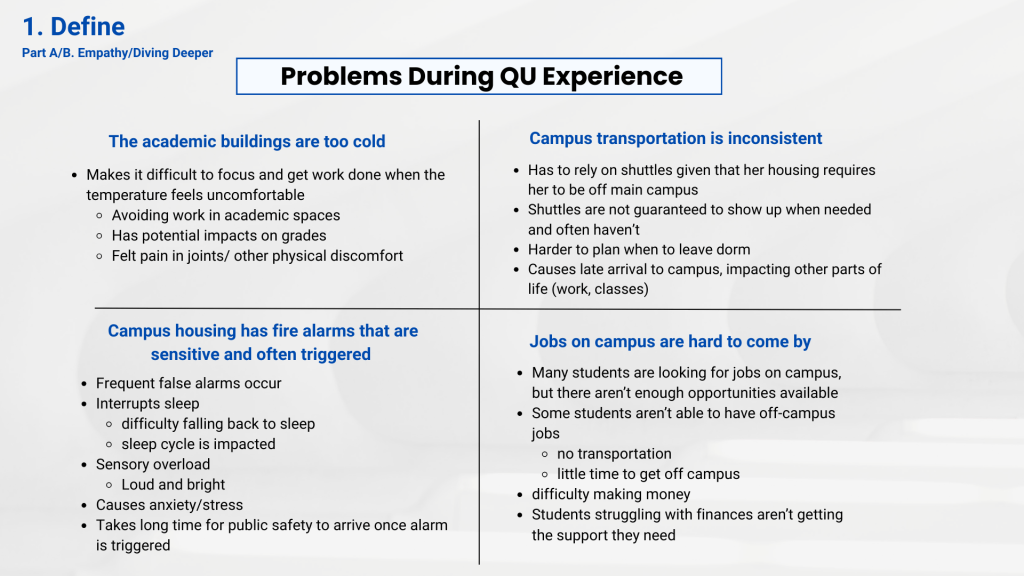
Defining Our Problems
Every problem we discussed about the University was something I had experienced firsthand as a student on campus. And at first, the interview felt more like a mini rant session, but I think that actually helped. Having those shared thoughts made diving deeper into the issues a lot easier because I had already understood the struggles, and it became clear that the effects of these problems are what have made them so personal.
This is the stage in a design sprint where the goal is to really get into someone else’s shoes and understand their challenges. The ideas that come next all depend on feedback that is specific, personal, and rooted in real experiences.
We ultimately identified four main issues that everyone agreed were contributing to our experience at Quinnipiac being less than ideal: campus temperatures, inconsistent transportation, a lack of job opportunities available to students on campus, and, finally, the reliability of fire alarms in QU housing.
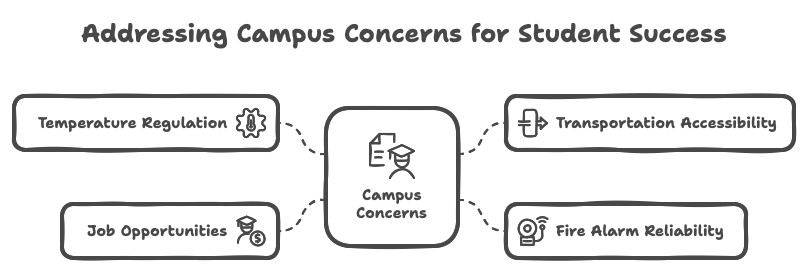
(Note: We were focused on identifying problems, so these are just small areas we felt could use improvement.)
Picking my Battles
After some thought, I realized the area where I had the most insight and the best chance to make a difference was campus transportation. If you are a Quinnipiac student, you already know the struggle. The University even tried to improve things with a live shuttle tracking app, which sounds great in theory. In reality, it is not very helpful when three shuttles pull up to the same spot at once, leaving other locations completely empty.
The result is always the same. Students show up late to class, stress about making it to work on time, or end up waiting around with no way to plan their day. Something as simple as getting from point A to point B has become a daily source of frustration.
With that in mind, I started brainstorming ideas to address these transportation challenges. To help guide me, I wrote a problem statement and a “how might we” question:
“Campus transportation is a challenge for Quinnipiac students (i.e., Dylan) because the shuttle system and schedule are inconsistent and unreliable…
How might we: Help QU students (like Dylan) have better/more reliable experiences with transportation to and from campus?”
Research Research Research
One of the most valuable parts of this design sprint was realizing how important it is to research how others have solved similar problems. I spent time looking into what other universities have done to improve their campus transportation systems and pulled out the ideas that felt realistic and possible for Quinnipiac to implement.
The most popular solutions were as follows:
- Bike Rental Programs
Bike Rental Programs
E-Scooter and E-Bike Programs
Car-sharing Apps
Carpooling incentives
Weekly campus traffic surveys
I presented these ideas to my group and got a lot of helpful feedback on which directions to take next. Most of their concerns centered around the financial costs for students, along with questions about safety and whether drivers from ride-sharing apps would even be allowed on our gated campus.
On top of that, bike rental programs came with their own set of challenges, from maintenance issues to the simple problem of bad weather making them unreliable.
This is when I really started connecting the dots from all the notes I had taken throughout the process and it was clear that car-sharing apps was something I wanted to work with.
The final Prototype
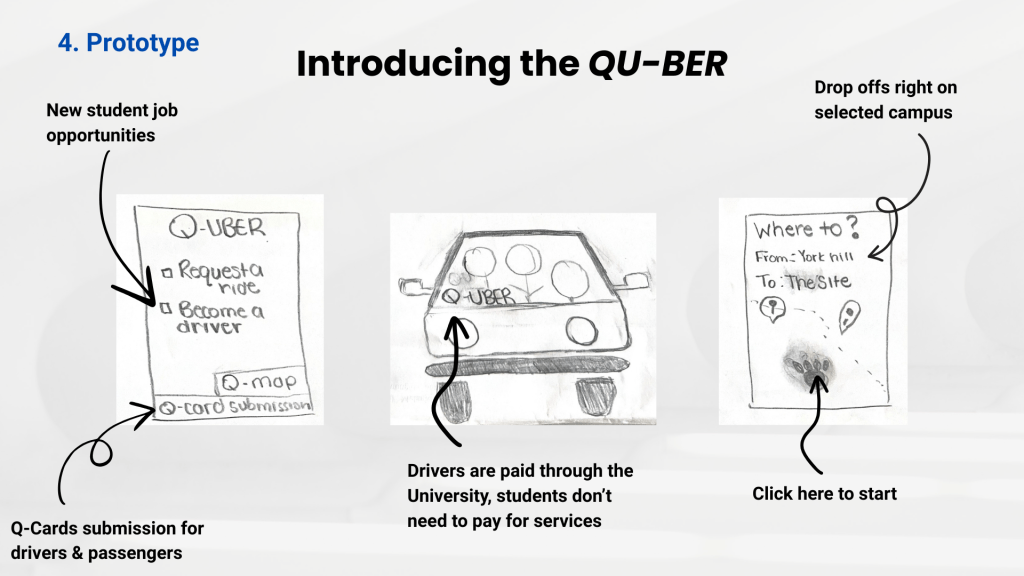
For my final prototype, I present the QU-BER, a campus ride-sharing concept built specifically for Quinnipiac students.
The idea is simple: students can either request a ride or sign up to become a driver, creating new on-campus job opportunities. Everything would be managed through the University, meaning drivers are paid directly, and students would not need to cover ride costs themselves. To ensure safety, both riders and drivers would be required to submit their Q-Cards for verification before using the service.
The app would allow students to choose pick-up and drop-off points directly on campus, making transportation faster and more reliable than the current shuttle system. With QU-BER, the goal is to provide a flexible, student-run alternative that keeps everyone moving without the stress of long waits or missed shuttles.
Even though I know the concept still needs a lot of tweaks and edits, my group gave me tons of feedback, including questions about how far it can travel and how to prevent students from taking advantage of it. Still, I think this is a solid final prototype to kick things off before getting into all the nitty-gritty details.
Overall, participating in this design sprint was a really valuable experience. It challenged me to think creatively, gather feedback quickly, and alter my ideas in a short amount of time. I learned a lot about balancing larger concepts with practical details, and I enjoyed seeing my prototype come together. I’ve included a PDF attachment of the full design sprint for anyone who wants to explore the process and all the steps in more detail. Let me know what you think!
 A Master in the Making
Leave a comment