Designing People: My Journey in Creating Personas
Why Create Personas?
I am not sure if this is a shared experience, but have you ever thought about creating the ideal best friend or partner, and how all the different pieces of a person come together to make them who they are? I used to joke with my friends that my perfect man would have the looks of Robert Pattinson and the humor of Adam Sandler.
In a way, that same idea of combining traits to form one complete picture is exactly what creating personas is about. In fact, this is an extremely common technique used by companies to help create the perfect representation of their audience. Instead of focusing on one single customer, personas bring together shared characteristics, needs, and motivations to build a character that feels real.
These research-based profiles help teams step into the shoes of their users so they can design with empathy and purpose. We take real qualities, goals, and challenges from different people and blend them into one profile that represents a larger group.
This is exactly what I did for this week’s persona project, creating two personas for Canva users, including one based on myself. I used the Persona Notepad from Ben Le Ralph’s article “Creating Personas” to map out demographics, goals, challenges, and motivations, and conducted research to make the profiles as realistic and actionable as possible.
Looking in the mirror: Making My Own Persona
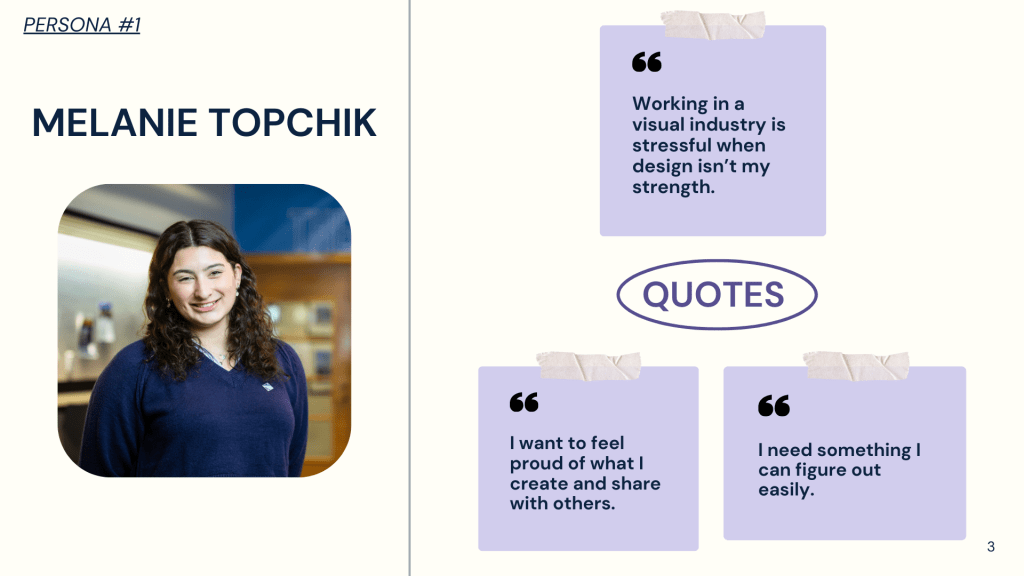
Starting with my own persona, the first step was to reflect on what I really need as a user, especially as a college student who frequently uses Canva for school assignments, internship tasks, and side projects. I mapped out my demographics, personality traits, goals, and the challenges I face regularly. Doing this helped me see patterns in my own behavior and decision-making.
Next, I looked closely at how I have been already using Canva, paying attention to what works well and where I often run into frustration. I considered the features I rely on most, like pre-designed templates, color palettes, and drag-and-drop functionality, and noted moments when the tool either helped me work efficiently or slowed me down. For example, I often feel frustrated when templates feel overwhelming or when certain features require skills I haven’t fully developed yet
I also made sure to capture not just my goals but my motivations and pain points. This process made my own relationship with Canva much clearer and more structured. By treating myself as a broader persona, I could see how personal experiences translate into valuable insights that can inform thoughtful design decisions for tools like Canva.
I also want to mention that creating my own persona really helped me understand my needs, behaviors, and frustrations in a structured way. It highlighted the features that really matter to me and revealed points where design could be improved to better understand users like me.
Meet Marcus: The Small Business Persona
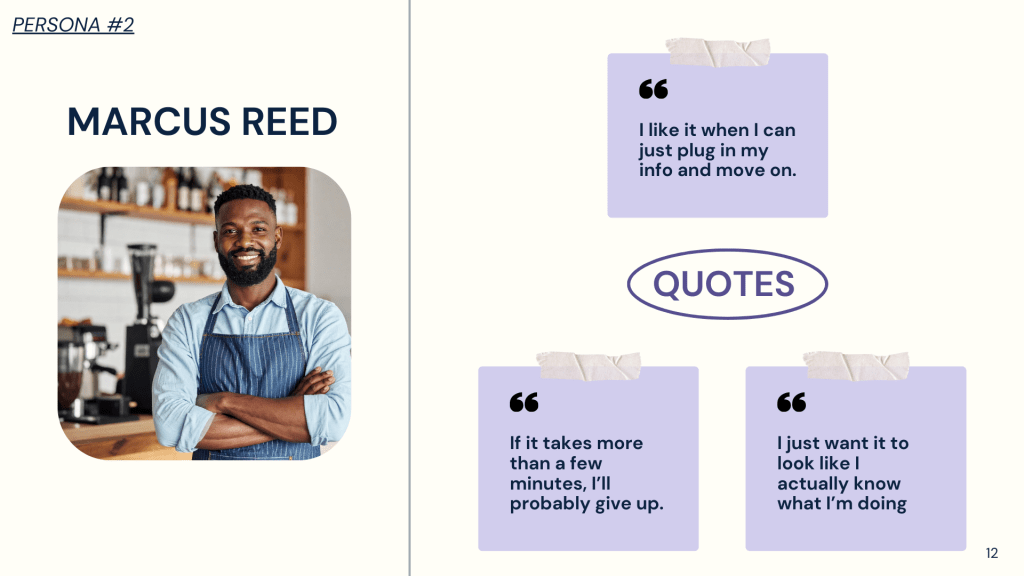
After exploring my own experiences, I created Marcus, a 34-year-old coffee shop owner in Austin, Texas. Unlike my college student perspective, Marcus has to manage operations, employees, and customer experience, while also handling marketing tasks like designing flyers, social media posts, and promotions.
To make his persona realistic, I followed the same structured template from Ben Le Ralph’s guide, mapping out his demographics, goals, challenges, motivations, and frustrations. Marcus is practical and creative, but he gets impatient when tasks take too long or require advanced design skills. His main goals are maintaining a professional, recognizable brand, keeping marketing consistent, and saving time and money by handling designs himself rather than hiring outside help.
I also considered his interactions with Canva specifically. Marcus relies on templates and drag-and-drop features to quickly create branded materials, but he can feel overwhelmed by too many options or limited by features that assume design experience. Capturing these details helped me understand not just what he does, but why he does it, which is exactly the point of creating personas.
By building Marcus alongside my own persona, I could compare the needs of different users, see overlapping challenges, and identify opportunities for design improvements that serve a wider audience.
Goals, Journeys, and Real Needs
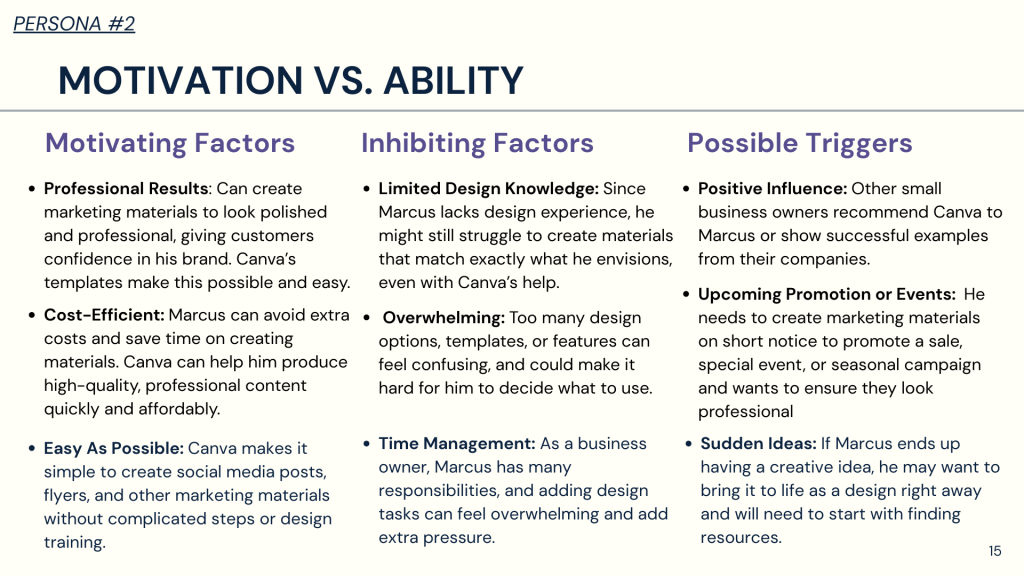
Once I had the basic profiles for myself and Marcus, I moved on to mapping out our goals and journeys. I wanted to go beyond simple statements like “create a flyer” or “finish a presentation” and understand the why behind each action.
For Marcus, designing a promotional flyer is not just about aesthetics. It is about building trust with customers, standing out from competitors, and keeping his brand consistent.
For me, using Canva effectively is about saving time, producing polished work for school or internships, and feeling confident in the outcome.
I captured not only what each persona was doing but also their motivations, frustrations, and the barriers that could prevent them from completing a task. This step made the personas feel much more real and actionable, highlighting areas where Canva could better meet user needs and making it clear why certain design decisions matter.
Seeing Patterns: Similar Personas
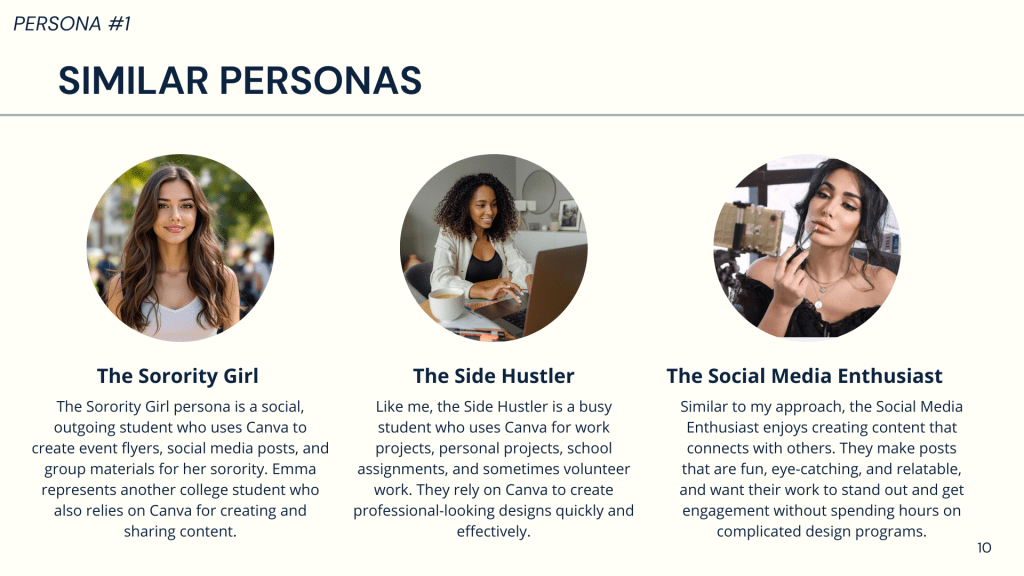
Creating both my own persona and Marcus’s allowed me to see patterns and similarities between users who, on the surface, seemed very different. Even though our lives and responsibilities are not the same, we share core needs when it comes to using Canva. Both of us want tools that are intuitive, visually consistent, and fast to use. We both get frustrated by too many choices, features that are complicated, or anything that slows us down from completing a task.
As I explored the assignment further, I also discovered other personas that shared traits with either me or Marcus.
For example, there was the sorority girl who needs Canva for quick and polished event graphics, the side hustler juggling multiple projects and needing efficiency, and the social media enthusiast focused on creating engaging content consistently. Each of these personas highlighted overlapping motivations and challenges, such as wanting efficiency, simplicity, and control over the design process.
- Why are students submitting late? → Because they miss the deadlines.
- Why do they miss the deadlines? → Because they are confused about when assignments are due.
- Why are they confused about the due dates? → Because the platform does not send clear reminders.
- Why does the platform fail to send reminders? → Because the notification system is not set up for each course properly.
- Why is the system not set up correctly? → Because instructors are not trained on how to manage notifications.
Recognizing these similarities was a key insight. It showed me that while each persona highlights unique goals, they also reveal shared needs that can guide design decisions. Understanding these patterns makes it easier to create solutions that serve multiple users at once instead of designing for one specific type of user.
By also comparing all of these personas side by side, I could identify opportunities where Canva could improve the experience for students, small business owners, and other related users.
What Personas Really teach us
Working on these personas side by side taught me how valuable it is to understand not just what users do, but why they do it. Even though myself, Marcus, the sorority girl, the side hustler, the social media enthusiast, and the various other personas I mention throughout the project all have very different daily lives, our needs often overlap. We all want tools that are efficient and reliable. We all get frustrated by unnecessary complexity or features that assume expertise we may not have.
Personas make these patterns visible. They show motivations, challenges, and goals in a way that helps prioritize design decisions. Instead of guessing what a user might need, you can base decisions on observed behavior and real-life scenarios.
As Ben Le Ralph emphasizes, personas are most effective when they combine research with storytelling, allowing teams to empathize with users and create solutions that really matter.
For Canva, building these personas highlighted areas where the platform could improve for a wide range of users. It also reinforced how valuable it is to approach design with empathy, whether you are creating for a small business owner, a busy student, or anyone in between.
Personas turn assumptions into insights and make designing for real human needs much more clear and intentional.
I have attached below my full project where I have created comprehensive personas. Let me know what you think!
 A Master in the Making
Leave a comment