
In this project, I applied design thinking to address user experience challenges in food delivery apps. The POV statements I worked from were developed last week based on research, including App Store reviews and user feedback, for Postmates, Uber Eats, and DoorDash. These statements provided a clear focus for this assignment, guiding my use of ideation techniques to generate solutions and improve the overall user experience.
Ideation is an extremely important phase in design thinking, focusing on generating ideas to address user-centered problems. As highlighted by the Interaction Design Foundation, ideation includes methods like brainstorming, SCAMPER, mind mapping, and rapid sketching, each serving distinct purposes in the creative process.
Using different ideation techniques helped me come up with lots of ideas and also focus on the best ones, uncovering solutions I might not have thought of without following a clear process.
Uber Eats POV statements
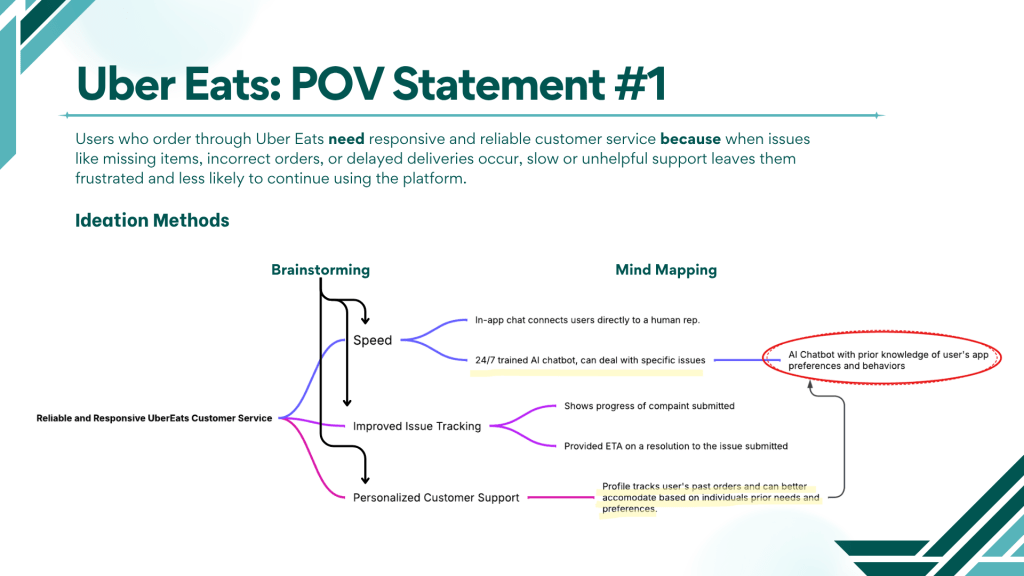
For the first Uber Eats POV, which focused on responsive customer service, I began by generating a wide range of ideas to explore all possible solutions. I then applied mind mapping to organize these ideas into categories such as speed, accessibility, and priority issues. This visual approach made it easier to identify patterns and connections among solutions, which clarified which ideas were most practical and impactful.
The strongest idea I developed was a 24/7 AI chat system that uses past order information to provide personalized responses, improving response times and enhancing the overall customer experience.
The second Uber Eats POV addressed consistent incentives and credits. I again generated a variety of ideas and then applied the Worst Idea technique to consider scenarios that would frustrate users the most. This helped me focus on which rewards or credit mechanisms were truly necessary for user satisfaction.
From this process, the most practical solution involved automating credits for late orders and creating a tiered loyalty rewards system to encourage repeat use, ensuring that customers will always feel fairly compensated when problems occur.
DoorDash POV statements
For the first DoorDash POV, which focused on transparent pricing, I started with brainstorming to capture a broad range of potential solutions. This helped me quickly record all ideas, including straightforward options such as providing a detailed fee breakdown at checkout or clearly displaying delivery costs.
After gathering these ideas, I applied the SCAMPER technique to explore ways to modify, substitute, or simplify the pricing system further. This process helped me refine my initial ideas and identify the strongest solution: implementing a flat-rate delivery fee, clearly displayed at checkout, which makes pricing easy to understand and consistent for users.
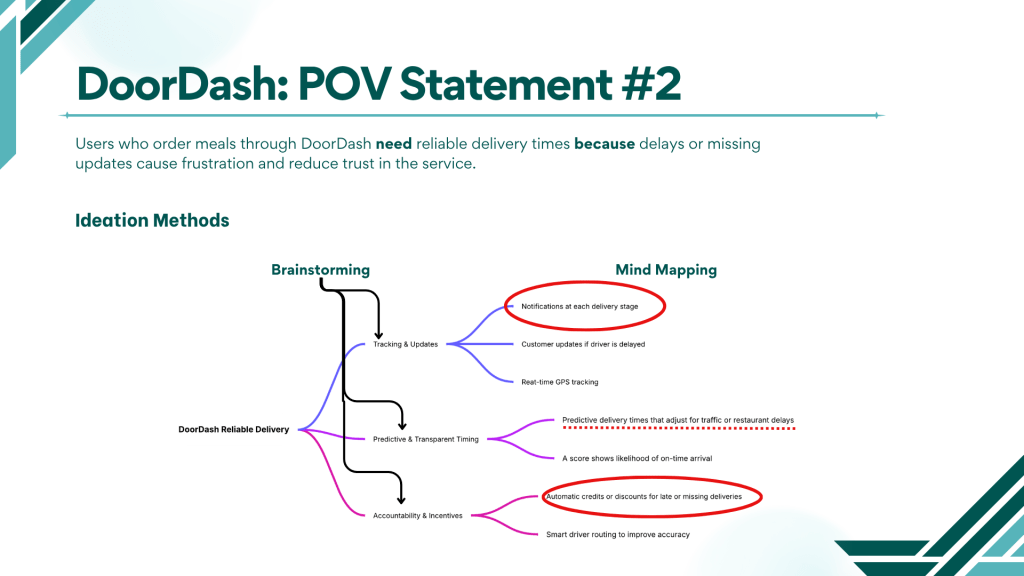
The second DoorDash POV dealt with reliable delivery times. I initially generated a broad range of ideas to explore different ways to improve punctuality and customer communication. While this may seem very similar to what I have done to come up with solutions to other POV statements, I felt it worked best in helping me get my first thoughts out in front of me.
I then used mind mapping to organize these ideas into themes, such as notifications, timing, and compensation.
From there, I was able to identify connections among solutions and determine which would be most effective. The strongest concept involved providing push notifications at each stage of delivery and offering automatic credits or discounts for late orders.
Postmates POV statements
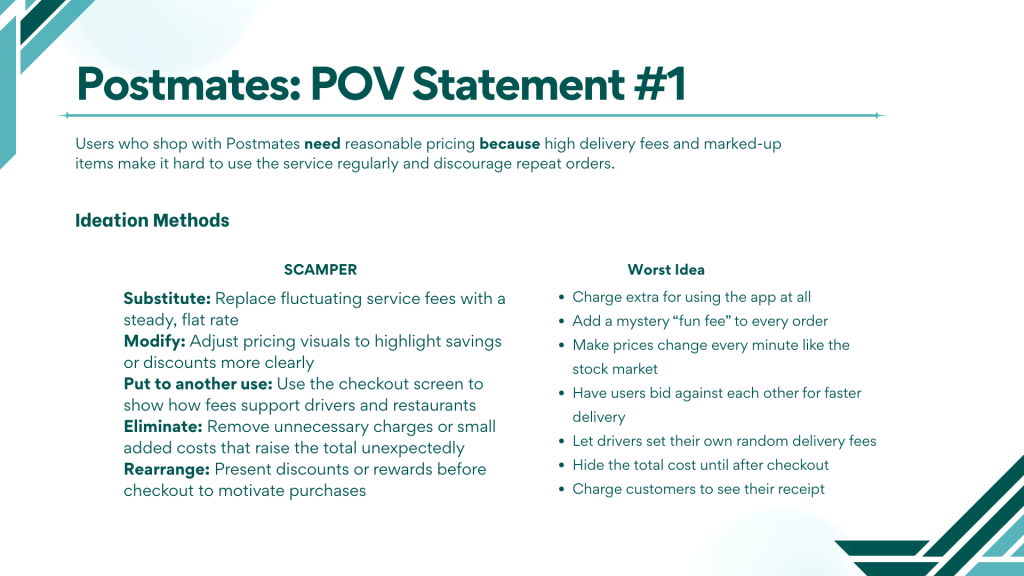
For the first Postmates POV, which focused on reasonable pricing, I began with the SCAMPER technique to explore ways the pricing system could be modified, simplified, or combined with other features. This approach allowed me to generate structured ideas and consider practical adjustments, such as eliminating hidden fees or bundling deliveries to reduce costs.
I then applied the Worst Idea technique to push my thinking further by imagining extreme or frustrating pricing scenarios. I must admit, this process is incredibly enjoyable, and it has made me realize how important it is to consider all thoughts (no matter how silly they may be), especially when the goal is to be as creative as possible.
Considering these exaggerated examples helped me recognize which solutions were most essential for users, leading to the idea of a transparent flat-rate delivery fee displayed upfront.
For the second POV, which addressed accessibility in the app interface, I started by generating ideas for improving usability and reducing navigation challenges. I then used rapid sketching to visualize potential layouts, button sizes, and icon placement, which made it easier to see how the interface could be simplified and more user-friendly.
Using both techniques together helped me develop my ideas into a simplified home screen with larger, clearly labeled icons, making the app easier and more intuitive for all users.
Reflecting on the Ideation Process
- Why are students submitting late? → Because they miss the deadlines.
- Why do they miss the deadlines? → Because they are confused about when assignments are due.
- Why are they confused about the due dates? → Because the platform does not send clear reminders.
- Why does the platform fail to send reminders? → Because the notification system is not set up for each course properly.
- Why is the system not set up correctly? → Because instructors are not trained on how to manage notifications.
- Recognizing these similarities was a key insight. It showed me that while each persona highlights unique goals, they also reveal shared needs that can guide design decisions. Understanding these patterns makes it easier to create solutions that serve multiple users at once instead of designing for one specific type of user.
This assignment really showed me how useful it can be to apply different ideation techniques to tackle problems in a structured way. By using mind mapping, Worst Idea, SCAMPER, and rapid sketching with the POV statements, I was able to generate a wide range of ideas while also identifying solutions that felt practical and user-friendly.
Each technique offered something unique: some helped me think creatively in a more organized way, others made it easier to see connections between ideas, and some revealed potential challenges I hadn’t considered. Working through the process made it clear how these methods can lead to meaningful improvements not only for user experiences in food delivery apps but also for any creative problem-solving project.
Below, I’ve included a PDF of my ideation techniques, methodology, and process for the assignment. I’m excited to hear any feedback or thoughts you might have!
 A Master in the Making
Leave a comment