

When something goes wrong in a user experience, the first explanation is rarely the real one. Users might abandon a form, ignore a feature, or struggle to complete a task, but those behaviors are usually symptoms of a deeper issue. This is where the Five Whys Analysis comes in, a UX research and problem-solving method that helps designers move beyond surface-level explanations and uncover the underlying causes of user pain points.
Instead of asking what is happening, the Five Whys forces you to ask why it is happening, repeatedly, until the root cause becomes clear.
What Is the Five Whys Analysis?
The Five Whys Analysis is a qualitative main-cause technique in which a team repeatedly asks “Why?” in response to a specific problem. Each answer becomes the basis for the next question, helping teams move step by step toward the true cause of an issue.
Think of it as tapping into your “inner toddler.” We’ve all been around that one kid who, no matter what answer you give them, immediately fires back with a relentless “But why?” While that loop might be exhausting for parents, it’s actually a top-tier example in root-cause analysis. In the world of UX, this “toddler logic” is essential to getting accurate data. It pushes us to stop settling for lazy excuses like “Because that’s just how we’ve always done it” and forces us to keep digging until we find the truth.
In UX research and design, the Five Whys is commonly used during discovery phases, usability testing, post-launch reviews, and when reviewing patterns in analytics data. According to the Interaction Design Foundation, this method helps teams challenge assumptions and better understand user behavior, rather than jumping to quick conclusions.
Despite the name, the process does not require exactly five questions. The goal is to continue asking why until the insight becomes actionable. To turn ideas into action, the Five Whys follows a structured, step-by-step process. Each step builds on the previous one, guiding teams from identifying a surface-level UX issue to uncovering a root cause that can be addressed through research or design changes.
Using the Five Whys in UX
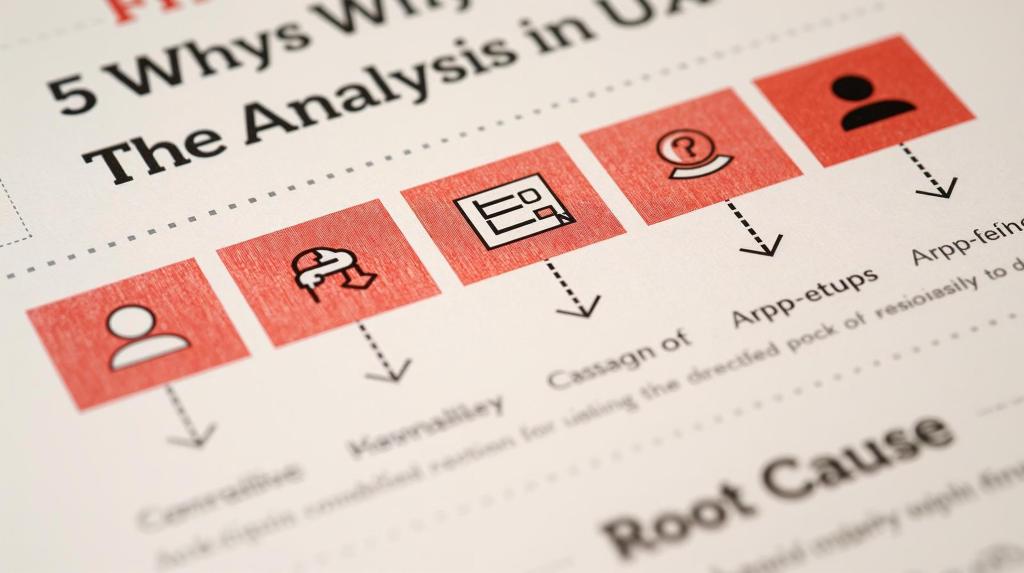
The Five Whys works best when it is structured, evidence-based, and guided by UX research practices. Each step benefits from grounding your questions in credible UX frameworks rather than opinion or instinct.
Step 1: Clearly Define the Problem
Before asking any “why” questions, you must clearly and objectively define the problem. In UX, this means focusing on observable behavior rather than assumptions about user intent.
For example, instead of saying “users do not like the checkout,” a clearer problem statement would be “35 percent of users abandon the checkout flow before completing payment.” When everyone is aligned on what’s actually happening, the “why” questions become more meaningful, and the insights that follow are much more useful.
The University of Glasgow UX Toolkit emphasizes that the Five Whys fails when teams begin with vague or emotional problem statements. According to their UX guidance, poorly defined problems often lead teams to stop questioning too early or arrive at causes that cannot be acted upon. By starting with a measurable UX issue, the Five Whys becomes a tool for insight rather than speculation.
Step 2: Ask the First “Why” Using Evidence
Once the problem is defined, the first “Why?” should be answered using existing UX data, not guesses. This might include usability testing results, session recordings, analytics trends, or direct user quotes.
The Interaction Design Foundation explains that the purpose of the Five Whys is to surface deeper user needs and system constraints, not to validate internal opinions. In other words, the method pushes designers to move beyond surface-level reasoning and examine the underlying causes of user behavior and system performance. As previously noted, this means every answer should be supported by evidence of what users actually did or said.
For example:
Why are users abandoning checkout?
Because usability testing showed that users felt overwhelmed by the number of required steps.
This keeps the analysis based on real user behavior rather than internal assumptions.
Step 3: Continue Asking “Why” to Challenge Assumptions
As you continue asking “Why?”, the focus should shift from interface-level issues to design decisions, assumptions, and processes. This is where the Five Whys becomes especially valuable in UX.
UX learning platform UXcel notes that many UX problems persist because teams stop questioning once they encounter a design flaw, rather than asking why that design decision was made in the first place.
For example:
Why does the checkout have so many steps?
Because the team wanted to collect detailed user information early.
Why did the team want to collect that information early?
Because they assumed it would improve personalization.
Why was that assumption made?
Because it was never validated through user research.
At this stage, the Five Whys reveals that the root cause is not the UI itself, but a lack of early research and assumption testing.
Step 4: Identify a Root Cause That Is Actionable
A true root cause should point toward something your UX or product team can change. If the final answer still sounds like a surface issue, the analysis should continue.
According to the Figma Resource Library, successful Five Whys sessions end with causes tied to process gaps, research blind spots, or decision-making patterns. These are areas where UX teams can realistically intervene through testing, iteration, or workflow changes.
In the checkout example, the root cause is an untested assumption about personalization rather than the form’s length.
Step 5: Design and Validate Solutions
Once the root cause is identified, UX teams should design solutions that directly address it and then validate those solutions through testing.
The University of Glasgow UX Toolkit recommends pairing the Five Whys with usability testing or prototyping to confirm that the proposed solution actually resolves the original problem. In UX practice, this might include testing a guest checkout option or delaying account creation until after purchase.
This final step ensures that the Five Whys leads to measurable improvement, not just insight.
Tools Commonly Used for Five Whys Analysis in UX
Although the Five Whys Analysis is intentionally simple, the tools used to support it play an important role in how effective the process becomes. Tools help teams visualize reasoning, document assumptions, collaborate across disciplines, and connect root causes back to user research findings.
Figma and FigJamthe process’s effectiveness

Figma and FigJam are widely used by UX teams because they allow researchers and designers to visually map each “Why” in a collaborative environment. In a Five Whys session, teams often place the initial problem statement at the top of the board and then create a vertical or horizontal chain of sticky notes, each representing a successive “Why.”
According to the Figma Resource Library, visual mapping helps teams see how quickly surface-level issues turn into deeper process or research gaps. This is especially valuable in UX because many root causes stem from assumptions made earlier in the design lifecycle. FigJam also allows teams to attach supporting evidence, such as usability quotes, screenshots, or analytics, directly to each “Why,” keeping the analysis grounded in real user data.
This makes Figma particularly useful in classroom settings and cross-functional UX teams, where transparency and shared understanding are critical.
Miro

Miro is another powerful tool for Five Whys analysis, especially for remote or hybrid teams. Miro provides structured templates that guide users through the process step by step, helping prevent teams from skipping steps or settling for shallow answers.
According to Miro’s UX learning library, The Five Whys works best when teams slow down and document each answer carefully. Miro’s infinite canvas allows teams to explore multiple “Why” paths at once, which is helpful when a UX issue has multiple contributing factors.
In UX research, this flexibility allows teams to identify whether a problem stems from interface design, content clarity, system limitations, or flawed assumptions. Miro is often used during design sprints, retrospectives, and post-usability-test debriefs.
Lucidchart and Creately

Lucidchart and Creately are diagram-focused tools that are particularly useful when documenting Five Whys findings in a polished, professional format. These tools allow teams to turn informal brainstorming into clean cause-and-effect diagrams that can be included in research reports or stakeholder presentations.
Lucidchart explains that Five Whys diagrams help communicate not just the final root cause, but the reasoning behind it. In UX, this is important because stakeholders often want to understand why a particular design decision is being recommended. Showing the full chain of reasoning increases trust in UX research outcomes.
Creately offers structured Five Whys templates that can be reused across projects, making it easier for teams to standardize their problem-solving approach.
Low-Tech Tools: Whiteboards and Sticky Notes
Despite the availability of digital tools, many UX teams still rely on whiteboards and sticky notes when conducting Five Whys sessions in person. Physical tools encourage participation, reduce overthinking, and make it easier for teams to rearrange ideas as new insights emerge.
In educational UX settings, this hands-on approach often helps students better understand how each “Why” builds on the previous one. It also reinforces that the value of the Five Whys lies in the thinking process, not the technology used.
Research Studies That Use or Evaluate the Five Whys Method

While the Five Whys is widely used in industry, several academic and applied research studies have examined its effectiveness and the conditions under which it yields the best results.
Study 1: Evaluating the Effectiveness of Five Whys in Organizational Problem Solving
A peer-reviewed study published in Quality Innovation Prosperity analyzed how organizations apply the Five Whys method in real problem-solving contexts.
The researchers found that teams who treated the Five Whys as a structured analytical method, rather than casual brainstorming, were significantly more successful at identifying true root causes. Teams that rushed the process or relied on opinion instead of evidence often stopped at symptoms rather than causes.
This finding is especially relevant to UX research, where it is easy to mistake user complaints for root problems. The study reinforces the importance of grounding each “Why” in observable data, such as usability test results or analytics, rather than internal beliefs.
Study 2: Facilitated vs Unfacilitated Five Whys Sessions
A thesis study from Western Kentucky University examined whether Five Whys sessions led by trained facilitators produced better outcomes than unguided sessions.
The study found that facilitated sessions resulted in deeper questioning, fewer assumptions, and more actionable conclusions. Facilitators were more likely to challenge weak answers and push teams to continue asking “Why” when responses remained superficial.
For UX teams, this highlights the importance of having a UX researcher or design lead guide the Five Whys process. Facilitation helps ensure that insights are tied back to user research and that teams do not prematurely settle on convenient explanations.
Why This Depth Matters in UX
Together, these tools and studies show that the Five Whys is not just a simple questioning exercise. When supported by the right tools and applied with discipline, it becomes a powerful UX research method that uncovers deeper user needs, challenges flawed assumptions, and leads to more effective design solutions. By going beyond surface-level observations, designers can identify the root causes of user frustrations rather than simply addressing symptoms. This depth of understanding helps create experiences that are more intuitive, satisfying, and aligned with real user behaviors.
Ultimately, investing time in this kind of analysis strengthens the entire design process, enabling teams to make informed decisions that improve usability, increase engagement, and foster lasting user trust.
 A Master in the Making
Leave a comment