
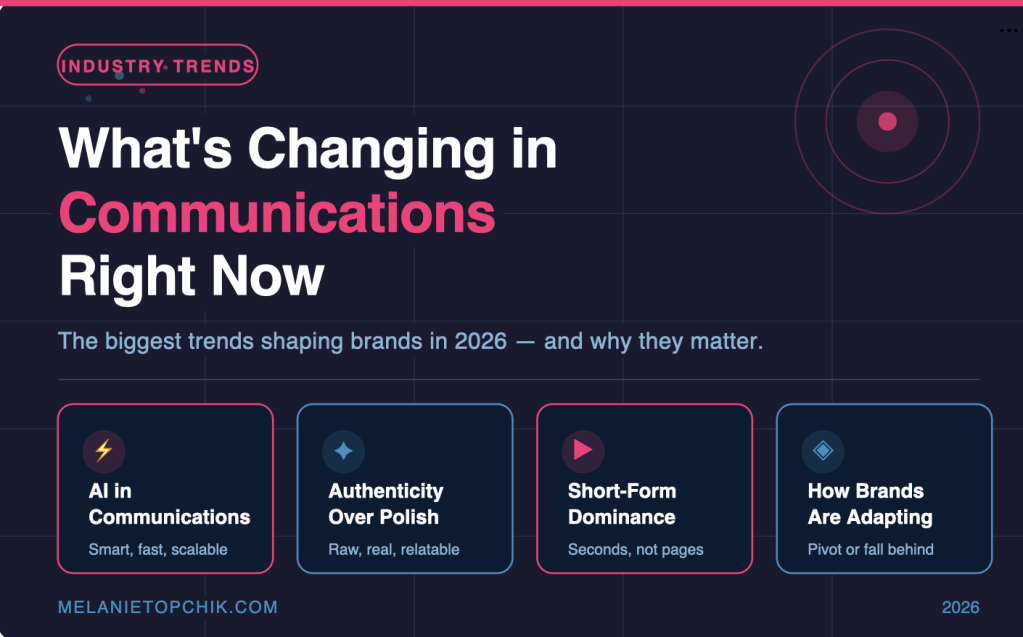
If you’ve been paying attention to brand communications lately, you may have noticed something feels… different. The perfectly curated content that dominated feeds just a few years ago is quietly losing ground to something messier, faster, and arguably more human. And behind the scenes, AI is reshaping how communications teams operate entirely.
So what’s actually changing, and why does it matter for your brand?
The Workhorse You Didn’t Hire…
Let’s get the obvious one out of the way. AI is no longer a buzzword in communications. It’s the baseline. Teams are using it to draft pitches, monitor brand sentiment, and generate content variations at a speed that simply wasn’t possible before. According to a Gartner survey, 80% of communications professionals expect to be using AI tools by 2026.
But here’s what I think gets missed in that conversation: the real skill shift isn’t about who can use AI fastest. It’s about who can use it most thoughtfully. Drafting and scheduling are handed off. The strategy, the judgment, the brand instinct? That stays human. The communicators winning right now are the ones who understand that AI raises the floor for output quality, which means the ceiling for standing out just got higher too.
Authenticity Over Polish
This one feels counterintuitive, but audiences are increasingly turned off by content that looks too good. A Clutch report found that 97% of consumers say authenticity influences their decision to support a brand, and that generic or robotic messaging is one of the fastest trust-killers.
My read on this: people have gotten very good at detecting performance. When a brand’s content looks like it went through six rounds of approval and a color-grading session, it signals that no real human was involved. What builds trust now is specificity, honesty, and the occasional rough edge. Behind-the-scenes content, real employee voices, opinions that actually take a stance. You don’t have to be unpolished. You just have to be real.
Short-Form Isn’t a Trend Anymore, It’s the Default
Short-form content has moved from “emerging format” to “baseline expectation.” Wyzowl’s data shows 77% of marketers believe short-form video delivers the highest ROI of any content format. And that instinct is bleeding into every channel, not just social. Press releases are getting TL; DRs. Emails are getting shorter. Even internal communications are shifting toward short video updates.
What I find interesting is that this doesn’t kill long-form. It just changes what long-form has to earn. A blog post, a case study, a well-researched article still has a place. But you have to hook someone in seconds before they’ll commit to minutes. Short-form is the door. Long-form is what’s behind it.
What This Means for Your Brand
These three trends are not separate conversations. They’re connected. AI accelerates content production. Authenticity becomes the filter that keeps that content from feeling hollow. Short-form becomes the delivery mechanism that meets people where they actually are.
The brands adapting well aren’t chasing all three simultaneously. They’re getting clear on their voice first, then letting these formats serve that voice. The brands struggling are the ones treating AI as a shortcut, polish as professionalism, and volume as strategy.
Which of these trends is your brand already navigating? Drop it in the comments!!
 A Master in the Making
Leave a comment