
Not every moment needs a statement. Not every controversy needs a comment. And not every trending topic needs your brand’s hot take.
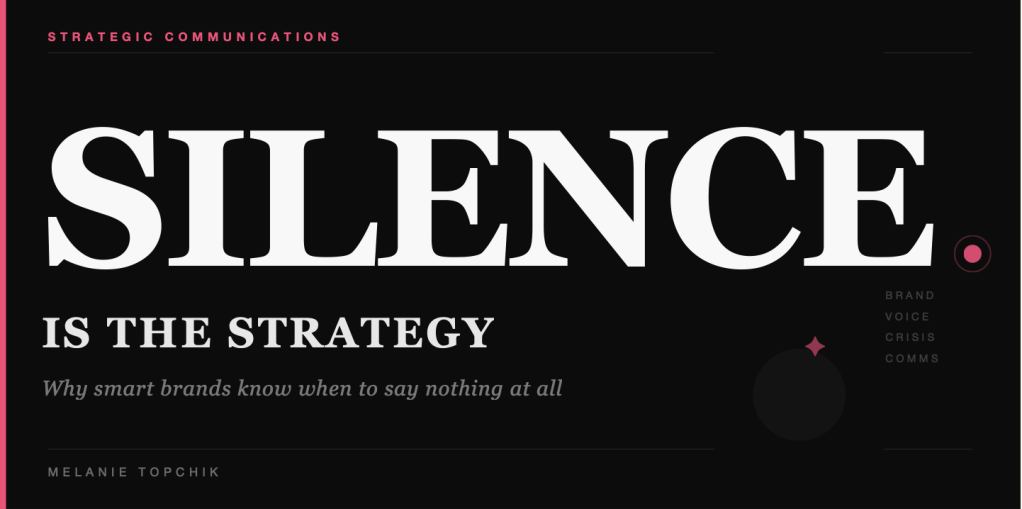
In a world where every brand has a social media account, a PR team on speed dial, and an apparently irresistible urge to weigh in on everything, there is a quiet power that most communicators overlook completely.
Saying nothing.
Not because you have nothing to say. But because you are smart enough to know that sometimes, the most strategic move is to put the microphone down and walk away slowly, with full eye contact.
Silence is a Choice, Not a Default
Here is what most communications courses do not spend enough time on: staying quiet is not passive. It is a deliberate, calculated decision that requires just as much strategic thinking as any campaign launch or press release. According to Harvard Business Review, the brands that navigate crises best are often the ones that resist the overwhelming urge to fill every silence with words.
Silence says: we are not rattled. Silence says: we do not owe the internet a reaction by noon. Silence says: we trust our audience to think critically without us performing for them. That is confidence. And confidence, as it turns out, is one of the most underrated communication strategies available.
When Staying Quiet Actually Worked
Apple is the gold standard here. For decades, Apple has deliberately said nothing about unreleased products, competitor jabs, or industry drama. While other companies were busy throwing shade in their ad campaigns and posting lengthy rebuttals, Apple quietly released another product that made everyone forget the argument entirely. Their silence created mystery, that mystery built loyalty, and that loyalty built a company worth more than most countries’ GDP. It’s hard to argue with results like that.
“The brands with the most powerful voices are not the loudest ones. They are the most intentional ones. Every word lands harder because they do not waste words.”
Patagonia is another example worth studying closely. When controversy swirls around topics outside their lane, Patagonia does not scramble to appear relevant. They stay in their lane, which is environmental activism, and they speak only when it connects directly to their established values. The result is a brand that feels coherent and trustworthy rather than opportunistic. Audiences notice that difference, even if they cannot always name it.
When Brands Spoke and Absolutely Should Not Have
Then there is the other side of this equation, which is considerably more entertaining to watch from a safe distance.
DiGiorno Pizza famously jumped on a trending hashtag in 2014 without pausing to check what it actually meant. The hashtag was #WhyIStayed, a deeply serious conversation among domestic violence survivors sharing their stories. DiGiorno posted a pizza joke. They deleted it within minutes, but the internet, being the internet, remembered forever. One impulsive post undid years of a genuinely fun and well-earned brand voice.
Then there is the category of brands that post a generic “we stand with you” statement during a cultural moment, follow it with zero substantive action, and then return to regularly scheduled promotional content within 72 hours. Edelman’s Trust Barometer has shown year after year that audiences are getting significantly better at spotting performative communication, and they like it considerably less each time they see it. Speaking without intention is not just ineffective. It is actively hurting the trust you have spent years building.
How to Know When to Hold Back
This is the real question, and there is no perfectly clean formula, which is probably why so many brands still get it wrong. But a few useful filters can help before you hit send on anything.
- Does this topic connect directly to our brand values, our audience, or our genuine area of expertise? If the answer is no to all three, sit down.
- Are we responding because we actually have something meaningful to add, or because we are afraid of looking like we are not paying attention? Fear is not a communications strategy.
- Will this still make sense in 72 hours, or are we riding a news cycle that will be completely irrelevant by Thursday morning?
- If we say nothing, what actually happens? Often, the honest answer is: not much.
Ragan Communications puts it well: the best communicators do not start by asking “what should we say?” They start by asking “should we say anything at all?” That single shift in framing changes everything about how you approach a moment.
The Master-in-the-Making Take
Studying integrated communications has made one thing consistently clear across every course, case study, and late-night reading session: the brands with the most powerful voices are the most intentional ones. Not the quickest ones. Not the loudest ones. The ones who have thought carefully about what they stand for before a crisis lands on their desk at 9pm on a Friday.
Strategic silence is one of the most sophisticated tools in a communicator’s kit. Learning when to use it is what separates the reactive from the truly strategic. And in a feed full of noise, a brand that knows when to say nothing ends up being heard more clearly than one that never stops talking.
Now, if you will excuse me… I am going to go practice what I preach and resist the urge to post about this immediately.
 A Master in the Making
Leave a comment