
Why User Reviews Matter
Food delivery apps have become part of daily life for millions of people, offering speed, convenience, and a wide variety of options. After spending time using these apps myself and analyzing hundreds of App Store reviews from other users, I realized that everyone has a unique perspective to share. Some praise and highlight certain features, while others describe frustrating experiences that make ordering more difficult.
Reading through these reviews provides a clearer picture of how these apps perform in real life. They reveal not only where the apps meet expectations and where they fall short, but also offer constructive feedback that can be a valuable resource for developers working to improve the user experience. This insight helps us understand what truly matters to users.
For this project, I analyzed reviews for Uber Eats, DoorDash, and Postmates to uncover recurring themes. From the data I found, I then crafted point-of-view (POV) statements, turning the user comments into clearer, actionable ideas that show what people really want from the app.
An Overview of Uber Eats Reviews
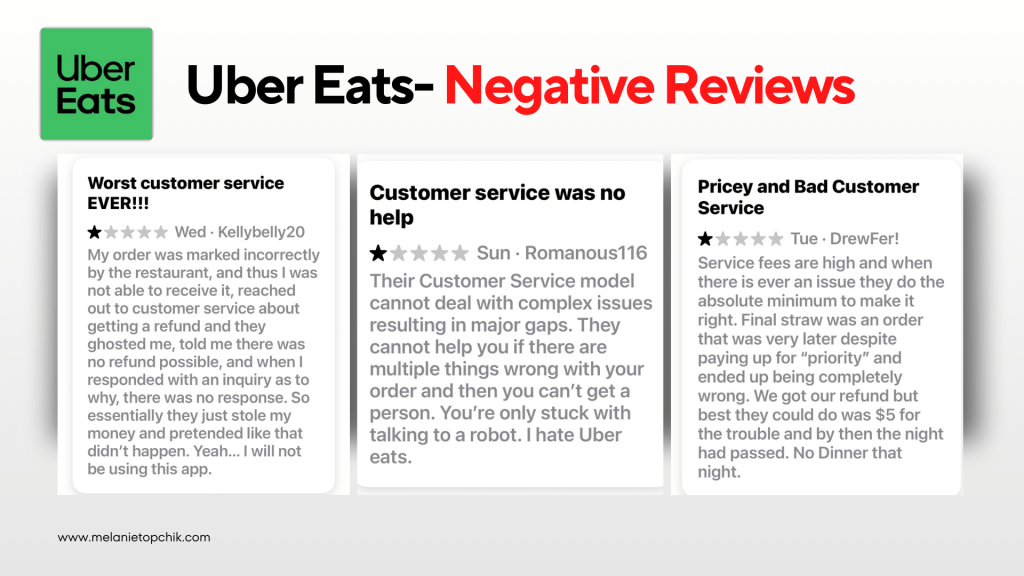
While many users enjoy the convenience of Uber Eats, some reviews highlight significant frustrations with customer service. One user wrote:
“My order was marked incorrectly by the restaurant, and thus I was not able to receive it, reached out to customer service about getting a refund and they ghosted me, told me there was no refund possible, and when I responded with an inquiry as to why, there was no response. So essentially, they just stole my money and pretended like that didn’t happen. Yeah… I will not be using this app.”
This review points out a recurring theme in the feedback: users need responsive and reliable customer support. When problems like missing or incorrect orders occur, slow or unhelpful responses can leave customers frustrated and decrease trust in the platform. Other users also highlight issues with unclear tracking and inconsistent communication with drivers, showing that convenience alone is not enough if problems cannot be resolved effectively.
DoorDash: Reliability and Pricing

DoorDash users frequently highlight the importance of reliable delivery times and transparent pricing. Positive reviews often mention that the app is straightforward and provides clear pricing information before checkout, helping users plan their orders with confidence.
However, many of the negative reviews emphasize frustrations with late deliveries, unclear updates, and hidden or inconsistent fees, which reduce trust in the platform. Users have also suggested improvements such as enhanced real-time tracking and better accessibility features for users with disabilities, showing that convenience and inclusivity are both priorities for customers.
These insights highlight that even when users enjoy the convenience of food delivery, reliability and fairness in pricing are essential to their continued engagement.
Postmates: Pricing, Accessibility, and Support

Postmates users often turn to the app for more than just restaurant meals, relying on it for groceries and other essentials. Reviews show that the app’s convenience is appreciated, but high delivery fees and marked-up item costs make regular use feel expensive.
Accessibility is another challenge, with users noting difficulties navigating the interface due to small buttons or extra pop-up ads. Slow or unhelpful customer service adds to the frustration. Users have suggested a more accessible interface and better compensation or lower delivery fees to make the app more user-friendly.
From these observations, two point-of-view statements stand out: Users who shop with Postmates need reasonable pricing because high delivery fees and marked-up items make it hard to use the service regularly. Users who rely on Postmates need responsive and helpful customer service because slow or unhelpful support diminishes trust in the platform. These insights make it clear that pricing, accessibility, and customer support are critical areas for improvement if Postmates wants to maintain loyal users.
Applying Design Thinking
I found that analyzing these reviews is similar to the “define” stage of the design thinking process, where understanding user needs is critical. As the Interaction Design Foundation explains in their article, Stage 2 in the Design Thinking Process: Define the Problem and Interpret the Results:
“Two goals of the define mode are to develop a deep understanding of your users and the design space and, based on that understanding, to come up with an actionable problem statement.”
By turning user feedback into POV statements, we can more effectively identify the most significant pain points and the best opportunities for improvement. This helps developers focus on what really matters to users, whether it’s more transparent communication, fair pricing, or a more accessible design. With this approach, app creators can prioritize solutions that make food delivery apps more reliable, efficient, and enjoyable for everyone.
- Why are students submitting late? → Because they miss the deadlines.
- Why do they miss the deadlines? → Because they are confused about when assignments are due.
- Why are they confused about the due dates? → Because the platform does not send clear reminders.
- Why does the platform fail to send reminders? → Because the notification system is not set up for each course properly.
- Why is the system not set up correctly? → Because instructors are not trained on how to manage notifications.
- Recognizing these similarities was a key insight. It showed me that while each persona highlights unique goals, they also reveal shared needs that can guide design decisions. Understanding these patterns makes it easier to create solutions that serve multiple users at once instead of designing for one specific type of user.
Below, I’ve attached my full project, including all types of reviews for each company and the POV statements I created based on them. I’d love to hear your thoughts!
 A Master in the Making
Leave a comment